
Oct 5, 2025
6
min read
Medically Reviewed
Share






The Growing Expectation for 24/7 Access
Australian patients have been trained by nearly every other industry to expect digital access at any hour. Banking, retail, travel and government services all offer self-service options outside business hours, and healthcare stands as the notable exception. The Royal Australian College of General Practitioners has documented that patient expectations around digital access are rising steadily, particularly among younger demographics who have never known a world without on-demand services and who find the concept of a phone-only booking system baffling.
Practices that fail to meet this expectation do not simply inconvenience patients — they actively lose them to competitors who offer a more convenient experience. Research published by the Journal of Medical Internet Research confirms that a significant proportion of patients will choose a different provider if online booking is not available, and the trend accelerates with each generation. The cost of a missed call or an unreturned enquiry is not merely a momentary frustration; it is a patient relationship that may never form at all, carrying long-term revenue implications that compound over years.
The data from the Australian Institute of Health and Welfare reinforces this picture, showing that after-hours GP access remains a persistent challenge across both metropolitan and regional areas. When patients cannot reach their regular practice outside business hours, they turn to emergency departments or after-hours clinics, fragmenting their care and increasing system costs. A digital front door directly addresses this gap by making the practice accessible whenever the patient needs it, strengthening the continuity that underpins quality general practice.
AI Phone Reception as the First Line of Access
The telephone remains the most common way patients initiate contact with a practice, yet it is also the most constrained access point. A human receptionist can handle only one call at a time, and once the queue builds, patients either hold indefinitely or hang up and call elsewhere. An AI receptionist such as MediQo’s CALLA module changes this dynamic fundamentally by answering every call on the first ring, at any hour, and handling the routine requests — booking, rescheduling, practice enquiries — without requiring a human to be free at that exact moment.
The value of AI phone reception extends beyond mere availability. Because CALLA operates inside the practice’s live schedule, it completes the booking in real time rather than taking a message for later manual action. The patient walks away from the call with a confirmed appointment time, and the practice avoids the administrative overhead of returning voicemails or chasing callback requests. Over a typical week, the cumulative effect is a dramatically more accessible practice that has not added a single staff hour to achieve it.
For practices that serve culturally and linguistically diverse communities, the language capabilities of modern AI reception are particularly valuable. CALLA can detect the language the patient is speaking and respond in that language, removing a barrier that often prevents patients from engaging with practices where their preferred language is not spoken at reception. This capability transforms the telephone from a source of frustration into a genuine tool for equitable access, reaching patient populations that have historically been underserved by traditional phone systems.
Expert Tips
"Most practice owners think they are competing on clinical quality alone, but patients judge the experience long before they reach the consult room. The first interaction — whether it is a phone call that rings out or a seamless online booking — sets the entire tone for the relationship. A digital front door is not a luxury add-on in 2026; it is becoming the minimum standard of care for patient access, and practices that ignore this shift are quietly losing market share to those that treat every touchpoint as part of the care experience." — Arash Zohuri, CEO, MediQo
Online Booking and the Self-Service Patient
Online appointment booking has moved rapidly from a market differentiator to a baseline expectation in Australian healthcare. Patients want the ability to see available slots, choose a convenient time and confirm their visit without making a phone call, particularly for routine consultations that do not require clinical triage. Practices that offer online booking consistently report higher patient satisfaction scores and lower rates of missed appointments, as the act of self-selection creates a stronger commitment to attending.
The critical factor distinguishing successful online booking from a frustrating experience is integration with the practice’s actual schedule. A booking widget that operates independently of the practice management system creates double-handling, manual reconciliation and the ever-present risk of double-bookings. When the booking tool writes directly into the same diary the reception team uses, the experience becomes seamless for everyone — the patient books with confidence, and the front desk works from a single, accurate source of truth without additional data entry.
Self-service booking also reduces the total call volume the front desk must manage, freeing reception staff to focus on patients who are physically present in the clinic. Every appointment that is booked online is one less phone call the receptionist needs to answer, which directly reduces the queue length during peak periods. Over time, this shift creates a virtuous cycle: the more patients use self-service options, the more reception capacity becomes available for complex enquiries and in-person support.
Key Takeaways
A digital front door extends practice access beyond traditional hours without requiring additional staff.
Patients increasingly choose providers based on digital convenience, making online access a competitive necessity.
Automated communication tools reduce no-shows and improve patient engagement between visits.
An integrated platform connects the front door with clinical and billing workflows for a seamless patient journey.
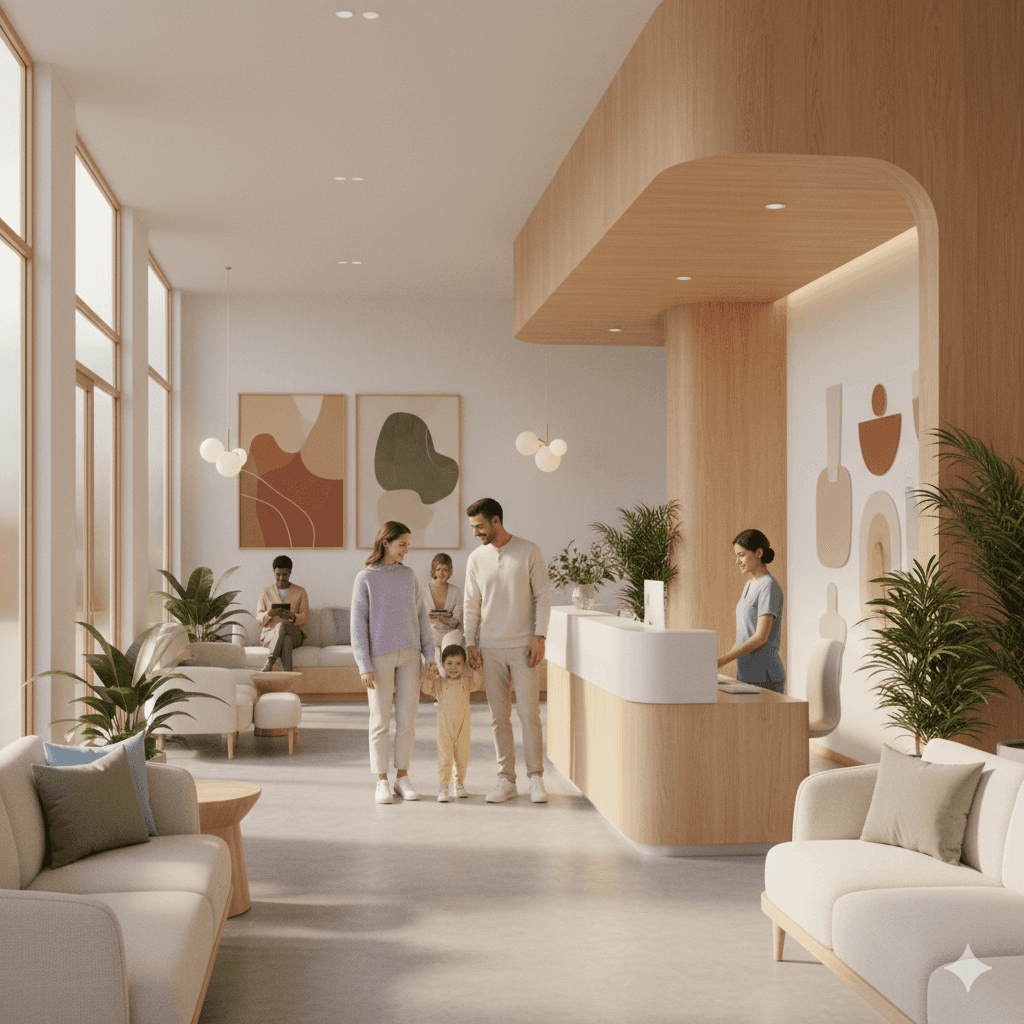
Consider a typical Australian family trying to book a GP appointment on a Sunday afternoon. The practice website lists a phone number that rings through to an answering machine. There is no online booking option, no way to ask a quick question and no method to check wait times. The family either waits until Monday morning, calls the nearest urgent care clinic or simply abandons the attempt altogether. This scenario plays out thousands of times every weekend across the country, and it represents a fundamental mismatch between what patients now expect and what most practices actually deliver.
A digital front door is the complete set of digital access points through which a patient interacts with a practice before, during and after their visit. It includes AI-powered phone reception that answers around the clock, online appointment booking integrated with the live schedule, patient portals that provide secure messaging and results access, and automated communication for recalls, reminders and follow-up care. A well-designed digital front door does not replace the human reception team — it extends the practice's availability far beyond the physical constraints of the front desk and the limits of traditional business hours.
This article examines why digital patient access has become a defining characteristic of successful modern practices in Australia. We explore the core components of a digital front door, the clinical and financial benefits of always-available access, and how practices can implement these capabilities without disrupting existing workflows. For practice owners evaluating their technology strategy, understanding the digital front door is essential to remaining competitive in an increasingly connected healthcare environment where patients expect the same convenience they receive from every other service they use.
Share